
Kullu district, located in Himachal Pradesh, has a long and fascinating past shaped by ancient traditions, powerful dynasties, and regional conflicts. Over the centuries, this Himalayan valley evolved from a land of local chiefs into a well-established state under various rulers.
From its early identity as Kuluta to the rise of the Pal and Singh dynasties, the history of Kullu reflects political struggles, cultural growth, and external influences from neighboring regions. This article provides a detailed account of Kullu history, covering its origins, major rulers, and key historical developments.
Table of Contents
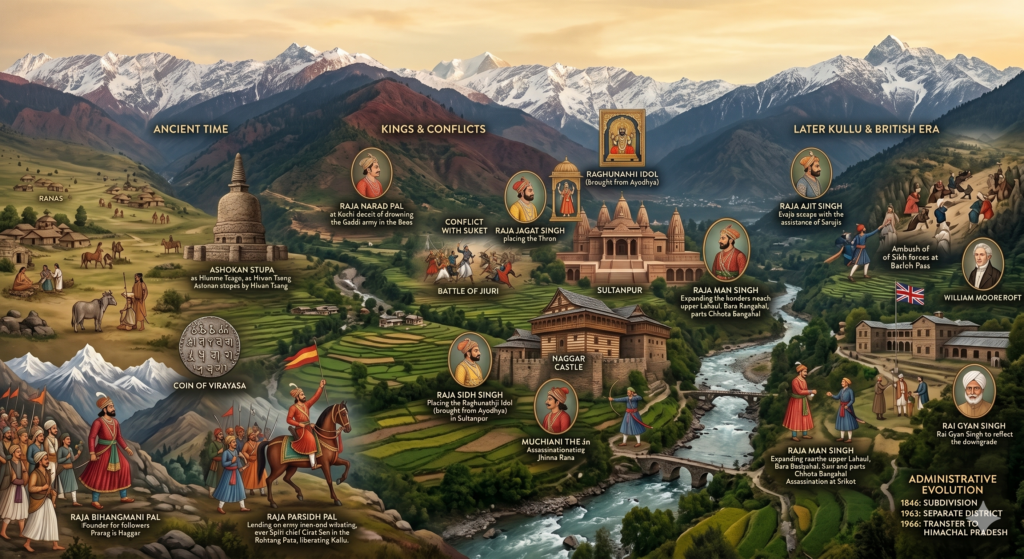
History of Kullu State: Comprehensive Revision Notes
1. Origins and Nomenclature
- Antiquity: Recognized as one of the most ancient states in the Punjab Hill states, ranked second only to Kashmir and Kangra.
- Original Name: KULUTA
- Traditional Folklore Name:Kulantapitha.
- Meaning: “The end of their inhabitable world” (considered by ancient people as the utmost limit of human abode).
2. Literary and Chronicle References
- Ancient Indian Texts: The name Kuluta appears in major texts including the Vishnu Purana, Ramayana, Mahabharata, Markandya Purana, Brihat Samhita, and Rajtarangini.
- Classical Literature: Mentioned in Bana’s Kadambari (7th century A.D.).
- Foreign Accounts (Hiuen Tsang, A.D. 630-644):
- Referred to the region as ‘K’ iu’ lu’ te’.
- Geographically placed it 187 miles North of Jalandhra.
- Documented an Ashokan Stupa in the middle of the valley, allegedly commemorating a visit by the Buddha.
- Religious Folklore Texts:Kulantapitha Mahatmya.
- Contains the traditional name of the region.
- Claims to be a part of the ancient Brahmanda Purana.
- Currently in the possession of the priests of Manikaran (Parbati valley).
- Neighboring Chronicles:
- Tibetan: Mentioned in the Ladakh chronicle ‘Gyalrabs’ (translated as the “Book of the kings”).
- Kashmiri: Referenced in the Kashmir chronicle of ‘Jonaraja’.
3. Epigraphical & Numismatic Evidence
- Numismatics (The Oldest Historical Record):
- A coin belonging to the Raja of Kullu, Virayasa.
- Discovery: First published by Sir A. Cunningham; correct reading established by Swedish scholar Dr. A.V. Bergny.
- Script: Features a full Sanskrit legend in Brahmi script, with exactly one word (rana) written in Kharosthi characters.
- Epigraphy (Copper Plate Title Deeds):
- Nirmand Copper Plate (7th Century A.D.): The oldest copper plate found in Kullu. Issued not by a Kullu Raja, but by Raja Samudra Sen (whose exact historical identity remains unconfirmed).
- Chamba Copper Plates (11th Century A.D.): Granted during the reigns of Soma-Varman and Asta-Varman. They contain references to Kullu concerning events from the reign of Chamba’s Sahila Varman.
4. Modern Sources of Historical Information
Because the overarching historical material for Kullu is generally scanty and unreliable, tracing its history relies heavily on these authenticated modern sources:
- Dr. Hirananda Shastri of the Archaeological Survey of India (ASI).
- The Vamshavali (The official Genealogical roll of the Rajas).
- Colonel A.P.F. Harcourt, primarily through his foundational book, “Kooloo, Lahoul and Spiti”.
The Pre-State Era: Rule of Ranas and Thakurs
- Predates the formal founding of Kullu state, which is assumed to have been established no later than the 1st or 2nd century.
- Nature of Rule: Local tradition, corroborated by the Vamshavali, indicates that Ranas and Thakurs held the territory either as independent rulers or under nominal subjection to a paramount power before the Pal dynasty arrived.
- The Ranas: Belonged to the warrior caste and most likely migrated from the Indian plains.
- The Thakurs: Were almost certainly Kanets.
Overview of Dynastic Records
- According to the Vamshavali (88 Total Rulers):
- The ‘Pal’ Line: Contains 73 names of Rajas.
- The ‘Singh’ Line (Later Line): Contains 15 names.
- According to Captain Harcourt (100 Total Rulers):
- The ‘Pal’ Line: Contains 85 names.
- The ‘Singh’ Line: Contains 15 names.
The ‘Singh’ Dynasty Timeline
- Establishment: Began around A.D. 1500.
- Downfall: Ended in 1840 following the overthrow of the state by the Sikhs.
- Duration: Ruled for a total period of 340 years,
Origins and Migration of the Royal Pal Line
- Ancestral Seat: The founders of the Pal line were from the plains, originally based at Prayag (Allahabad).
- Migration Route:
- They first migrated from Prayag to the mountains of Almora.
- Later moved westwards, conquering and settling at Mayapuri (Haridwar).
King-Wise Chronicles: The Early Pal Dynasty
I. Raja Bihangmani Pal (Founder of Kullu)
- Origin: Mayapuri.
- Key Companions: Rani, Son (Pachch Pal), Priest (Udai Ram).
- Campaign: Defeated chiefs in Parbati Valley.
- Exile: Took refuge at Jagat Sukh (sheltered by Chapai Ram).
II. Raja Pachch Pal
- Victories: Successfully defeated the Rana of Gajan and Bevala.
III. Surag Pal & Succession Dispute
- Conflict: Succession was contested by his two sons, Shakti and Janak, born at nearly the same time to different Ranis.
- Resolution: The Purohit (priest) decided in favor of Shakti Pal because he was the son of the elder Rani.
IV. Rajendra Pal
- Target Territory: Kothi Barsai, situated between Jagatsukh and Naggar.
- Ruler of Kothi Barsai : Ruled by Surat Chand, the Rana of Gajan.
- Political Opportunity to Rajendra Pal: Surat Chand died without a male heir, leaving only a daughter, Rup Sundari, as his successor.
- Initial Attempt: Rajendra Pal first tried to annex the territory by military force but was unsuccessful.
- Final Acquisition: Successfully merged the Gajan territory into his kingdom through a marriage proposal accepted by Rup Sundari.
V. Raja Visal Pal
- Conflict: Killed Karam Chand, the Rana of Naggar.
- Outcome: the Raja extracted tribute from the Rana’s son.
VI. Raja Visudh Pal
- Capital Shift: Moved the seat of government from ‘Nast’ (Jagat Sukh) to Naggar.
Conflicts with Spiti and Lahaul
I. Raja Rudra Pal
- Invasion: Kullu was invaded and subdued by the Raja of Spiti, named Rajendra Sen.
- Outcome: Rudra Pal was forced to pay tribute to Spiti.
II. Raja Hamir Pal
- Tribute Details: Continued the payment of tribute money to Spiti.
- Amount: The tribute amounted to six anna in the rupee of the yearly revenue.
III. Raja Parsidh Pal (Liberation)
- Resistance: Upon the death of Hamir Pal, Parsidh Pal declined to pay further tribute.
- Military Action: He moved with an army to oppose the Spiti chief, Chet Sen.
- Battle Site: The conflict took place in the area near the Rohtang Pass.
- Results:
- Liberated Kullu from the control of Spiti.
- Liberated Lahaul from the control of Chamba.
IV. Raja Sansar Pal (600-650 A.D.)
- Geopolitical Shift: During his reign, the Pre-Buddhist Hindu dynasty in Spiti was finally overthrown and became extinct.
- Tibetan Rule: The territory of Spiti subsequently passed under Tibetan rule.
Internal Succession Disputes
- Bagh Pal vs. Vibhay Pal: Civil war resulted in Bagh Pal’s death; Vibhay Pal took the throne.
- Brahm Pal: succeeded vibhay pal and Died without a legitimate heir.
- Ganesh Pal: Installed by an external confederation of Rajas (Kangra, Bangahal, Chamba, Bushahr, Suket, and Ladakh); authenticity of this event is considered unreliable.
KULLU KINGS: CONFLICTS WITH CHAMBA
I. Raja Dateshwar Pal (31st Raja)
- Conflict: Invaded by Meru-Varman of Chamba (Brahmpura) around c. A.D. 680–700.
- Outcome: Dateshwar Pal was defeated and killed in battle.
- Consequence: His son Amar Pal was also slain; Kullu fell under Chamba’s rule for several generations.
- Exile: His descendant Sital Pal fled to Bushahr to seek refuge.
II. Raja Jareshwar Pal
- Catalyst: Chamba was weakened by a Kira (Tibetan) invasion around A.D. 780–800, during which the Chamba Raja was killed.
- Liberation: As the sixth descendant from Sital Pal, he utilized this opportunity to free Kullu from Chamba rule.
- Allies: Secured the throne with military assistance from the Bushahr ruler.
III. Raja Narad Pal
- The 12-Year War: His reign was marked by a continuous 12-year war with Chamba.
- The “Gaddi Army”: Traditional name used to identify the invading Chamba forces.
- The Deceit at Kothi: Despite a concluded peace treaty, Kullu forces invited the Chamba army to a social gathering near village Kothi.
- Outcome: A large portion of the Chamba army was deceitfully drowned in the River Beas; survivors fled.
KULLU KINGS: CONFLICTS WITH SUKET
I. Raja Bhup Pal (43rd Raja)
- Contemporary: Ruled during the time of Bir Sen, the founder of Suket.
- Conflict: Bir Sen invaded Saraj, defeated Bhup Pal, and took him prisoner.
- Status: Kullu became a tributary state under Suket, requiring feudal services.
- Succession: His successor, Anirudh Pal, continued paying tribute.
II. Raja Hast Pal I
- Freedom Condition: Tribikram sen of suket asked hast pal for help during a civil war in return of freedom from tribute
- Suket Civil War: hast pal 1 Supported Tribikram Sen (younger brother of Suket Raja Bikram Sen) in an unfaithful attempt to seize the throne while Bikram Sen was on pilgrimage.
- Battle of Jiuri: Fought on the banks of the Satluj.
- Outcome: Hast Pal I and Tribikram Sen were both killed by Bikram Sen’s forces.
- Consequence: Bikram Sen seized Kullu; Hast Pal’s descendants were reduced to the status of Jagirdars.
III. Raja Surat Pal (Hasir Pal)
- Liberation: Freed Kullu while the Suket ruler Lakshaman Sen was still a minor.
- Reversal: Suketi records claim Kullu was subdued again 14 years later by lakshman sen.
- Discrepancy: This later invasion by Lakshaman Sen is not confirmed by Kullu chronicles
KULLU KINGS: CONFLICTS WITH TIBET, LADAKH, AND BALTISTAN
I. Raja Tegh Pal
- Baltistan Campaign: Supposedly conquered Baltistan by killing its chief, Mohammed Khan.
- Tributary Status: He reportedly made the chief’s son a tributary, though the authenticity of these claims is considered doubtful.
II. Raja Uchit Pal
- Invasion of Tibet: Launched a military invasion into Tibet.
- The Lhasa Capture: Upon Uchit Pal’s death, the Rajas of Lhasa , Lha Chen Utpala captured uchit pal ‘s son while the prince was performing his father’s funeral ceremonies.
- Imprisonment: The son was imprisoned in Mohangarh (located in Kothi Chaparsa, near the Bubu Pass) during the reign of Lha Chen Utpala (c. A.D. 1125–1150).
- Ladakh Tribute: To resolve the crisis, the King of Kullu bound himself by oath to pay a yearly tribute to the King of Ladakh.
- Tribute Items: The payment consisted of ‘dzos’ (a yak-cow crossbreed) and iron.
- Duration: This tributary obligation remained in force until the reign of Sengge Namgyal (A.D. 1590–1620) and even later.
III. Raja Sikandar Pal
- Appeal for Aid: He traveled to Delhi to lodge a complaint against Chinese aggression.
- Delhi’s Military Intervention: The Raja of Delhi personally led an army through Kullu to counter the threat.
- Extensive Conquests: The combined forces successfully conquered Gya Mur Orr, Baltistan, and Tibet as far as Mantilae (Mansarover) Lake.
- Historical Note: In ancient times, Lake Mansarover was referred to as Mantilae.
- Restoration and Diplomacy: The Rajas of Gya Mur Orr, Baltistan, and Tibet were mandated to pay tribute to Delhi through the Kullu Raja.
- Outcome: Sikandar Pal was successfully restored to his full dominions.
KULLU KINGS: CONFLICTS WITH BUSHAHR, KANGRA, AND BANGAHAL
I. Conflict with Bushahr
- Subjugation under Hast Pal II: The Raja of Bushahr invaded Kullu, exacted tribute, and established dominance.
- Duration: This tributary status persisted through the reign of Sasi Pal.
- Liberation: Gambir Chand (Pal) successfully freed the country from Bushahr’s control.
II. Conflict with Bangahal
- Capture under Narinder Pal: During his reign, Kullu was conquered by the state of Bangahal.
- Duration: The kingdom remained a subject territory of Bangahal for ten years.
III. Conflict with Kangra
- Tributary Status under Nand Pal: Kullu became a tributary to the powerful state of Kangra.
- Timeline: The state remained under Kangra’s allegiance until the reign of Dharti Pal.
- Recovery of Independence: Raja Inder Pal eventually threw off Kangra’s authority and restored Kullu’s independence.
LATER KULLU KINGS: THE PAL LINEAGE
I. Raja Keral Pal & Local Power Struggles
- Invasion: During Keral Pal’s reign, Kullu was again invaded by the Raja of Suket.
- Rana Bhoshal: A powerful petty chief controlling the region between Siunsa Nala and Bajaura.
- Alliances: He was married to Rupni, a princess of Suket.
- Fortifications: He resided at the palace of Garh Dhek and defended the massive stone fort of Baragarh.
- Capital: His seat of power was Sangor, located opposite Naggar.
- Wazir: His administration was managed by Tita Mehta.
II. Raja Urdhan Pal (72nd Raja)
- Reign: Ruled from 1418 to 1428 A.D..
- Architectural Contribution: Built the prominent Temple of Sandhya Devi at Jagatsukh.
III. Raja Kailash Pal (The Last “Pal”)
- Ascension: Came to power in 1428 A.D. and ruled until approximately 1450 A.D..
- Significance: He was the final ruler of Kullu to use the Pal surname.
The 50-Year Interregnum and Suket Dominance
Following the reign of the final Pal ruler, the Kullu valley entered a period of administrative obscurity and external subjugation.
- Chronicle Gap: After Kailash Pal (c. A.D. 1450), a significant 50-year break occurs in the historical records where no Raja is mentioned.
- Territorial Shift: During this vacancy, Suket successfully regained control over a large portion of the Kullu territory.
- Feudal Subjugation: Numerous local Ranas and Thakurs, who had previously been independent or loyal to Kullu, became tributaries to Suket during this era.
THE SINGH LINEAGE: EXAM FACTS (SIDH SINGH)
I. Raja Sidh Singh (c. A.D. 1500 – 1532)
- Ascension: Came to power after a 50-year interregnum following Kailash Pal.
- Lineage: The Vamshavali implies he was a descendant of the Pal family.
- Built Naggar Castle
- Defeat of Jhinna Rana:
- Jhinna Rana was a powerful chief ,holding both banks of the Beas above Jagatsukh, with strongholds at Madankot and Manali.
- Sidh Singh bribed an archer named Muchiani to assassinate the Rana near the rice fields of Kumanu and Rambar.
- Muchiani was rewarded for his deed with the Kumanu rice fields.
- The Rana’s wife committed Sati; both she and Muchiani’s wife are now worshipped as ‘Jogins’ (goddesses) at the ruins of Madanko.
- Jhinna Rana’s surviving son founded the ‘Nuwani family’, which held the royal privilege of erecting memorial stones for dead.
- Capture of Baragarh Fort:
- Following Rana Bhosal’s death, Baragarh was held by a Suket garrison.
- A female insider signaled Sidh Singh with a red petticoat when the garrison left for the ‘Pali jatra’ festival at Hurrah Kothi.
- Sidh Singh captured the fort via Sujoin Nala and immediately ordered the female informant thrown down a precipice.
RAJA BAHADUR SINGH
I. Key Dates & Relations
- Reign: Ascended A.D. 1532; succeeded by his son Partap Singh (A.D. 1559–1575).
- Contemporary: Ruled alongside Raja Arjun Sen of Suket.
- Chamba Alliance (A.D. 1559): Married three Kullu princesses to Pratap Singh, heir of Chamba’s probable ruler, Ganesh Varman.
II. Territorial Expansion
- Waziri Ruppi: Acquired diplomatically. The arrogant Suket Raja insulted the local Thakurs as “Crows of Ruppi”; Bahadur Singh won their allegiance by designating them “Lords of Ruppi”.
- Key Defeats: Killed Thakur Haul of Sainsar Kothi using a bribed relative (rewarded with a Jagir).
- Major Conquests: Expanded Kullu to include the Lag area, Sarvari valley, inner/outer Saraj, and parts of Chhota Bangahal.
- Border Legacy: These expanded boundaries remained unchanged until Raja Jagat Singh (A.D. 1637).
III. Capital & Architecture
- Makarasa Palace: Built a palace and rehabilitated Makarasa (mythologically founded by Makas, son of Mahabharata’s ‘Vidura’).
- Official Capital: Despite the new residence, the state capital remained at Naggar.
- Thakurai Subjugation: Completed the subjugation of local ‘Ranas’ and ‘Thakurs’ initially started by Sidh Singh.
RAJA JAGAT SINGH (A.D. 1637–1672)
I. Conquests & Expansion
- Territory: Annexed ‘Lag area’ and ‘Outer Saraj’ (from Suket/Bushahr).
- Forts Captured: Narsinghgarh, Srigarh, and Himgiri.
- Lag Campaign (c. 1650–55): Allied with raja of Mandi , Suraj sen to defeat the Lag rulers (Jai Chand and Sultan Chand); subsequently partitioned the Lag state between MANDI and KULLU .
II. The Curse & Theocracy (1653)
- The Curse: A Brahmin at ‘Tippari’ denied the Raja’s demand for pearls and self-immolated. Cursed (his food turned to worms), the Raja sought redemption.
- Raghunathji Idol: Brahmin Damodar Das brought the idol of Raghunathji from Ayodhya in A.D. 1653.
- Surrender of Power: Placed the idol on the throne (gaddi), ruling thereafter solely as the deity’s vice-regent.
III. Capital & Infrastructure (c. 1660)
- Capital Shift: Moved the state capital from Naggar to Sultanpur.
- Construction: Built a royal palace and the Raghunathji temple at Sultanpur.
- Residences: Alternated between Sultanpur, Naggar, and Thawa.
IV. Mughal Relations & Legacy
- Mughal Title: Aurangzeb was the only emperor to officially recognize him as ‘Raja of Kullu’ (12 previous farmans used ‘Zamindar’).
RAJA BIDHI SINGH (A.D. 1672–1688)
- Kullu and Lahaul had been tributary to Ladakh since A.D. 1125–50
- Strategic Advantage: Ladakh’s power had been greatly weakened by an Eastern Tibet invasion in A.D. 1646–47.
- End of Tribute:.he freed both from Ladakh in 1670-80
- Annexations: Captured the Kothis of ‘Dhaul’, ‘Kot Khandhi’, and ‘Baramgarh’ in outer Saraj from bushahr kingdom
RAJA MAN SINGH (A.D. 1688–1719)
I. The Zenith of Power & Territorial Extent
- Peak Glory: Kullu reached its maximum territorial extent and peak political power under his rule.
- Maximum Boundaries:
- North: Comprised Upper Lahaul, Bara Bangahal, and parts of Chhota Bangahal. Forced Ladakh to fix the border at the Lingti plain and compelled Spiti to pay tribute.
- South: Extended nearly to Shimla (including the Shangri state, east of the Satluj) and right up to the town of Mandi.
II. Major Conflicts & Annexations
- Mandi & The Bangahal Crisis (c. 1700):
- Invaded Mandi, initially conquering territory up to the Darang salt mines.
- Annexed Chhota and Bara Bangahal from Mandi.
- Political Context: The Raja of Bangahal, Prithi Pal (Man Singh’s brother-in-law), was invited to Mandi and treacherously murdered at Damdama Palace by Mandi’s Raja, Sidh Sen.
- Later repulsed a massive Mandi counter-invasion (attacking Garhchula, Madanpur, Bisturi, Tarapur) and forced Mandi to terms at Dhangi.
- Bushahr Conquest: Captured the Outer Saraj taluka (specifically the Kothi of Pandrabis) from Bushahr.
- Southern Expansion: Crossed the Satluj, seized Shangri from a local Thakur, and exacted tribute from the states of Kotgarh, Kumharsain, and Balsan.
III. Infrastructure & Fortifications
- Royal Residence: Built a new palace at Ratah village.
- Northern/Eastern Forts: Pandrabis, Dabkopochka, and Tangusta.
- Southern Forts: Kalgarh, Sirikota, Salachani, Ratu, Rararna, and Pagi.
IV. Tragic Assassination
- The Incident: Assassinated at Srikot (across the Satluj river) by the Rana of Kumharsain.
- Motive: The Rana killed him in retaliation because Raja Man Singh had fallen in love with the Rana’s wife.
Raja Raj Singh (A.D. 1719–1731)
- Sikh Guru Visit: Guru Govind Singh (the 10th Sikh Guru) visited Kullu seeking military aid against the Mohammedans.
- Outcome: Raj Singh refused to provide assistance.
Raja Jai Singh (A.D. 1731–1742)
- The Revolt: Expelled his wazir, ‘Kalu of Diyar’, who then orchestrated a major revolt from ‘Kareti’.
- Flight & Territory Loss: Jai Singh fled to Lahore seeking Mughal support. During his absence, Samsher Sen of Mandi invaded and captured the Chauhar territory.
- Exile: Never returned to Kullu; lived out his life in Ayodhya at ‘Ramdarbar’, devoted to worshipping Raghunathji.
III. Raja Tedhi Singh (A.D. 1742–1767)
- Internal Turmoil: Succeeded his elder brother, Jai Singh; his reign was plagued by continuous revolts.
- Bajaura Temple Desecration: Temple images were mutilated during an invasion, likely by Mohammedan mercenaries.
RAJA PRITAM SINGH (A.D. 1767–1806): REVISION NOTES
- Initial Victories: Immediately after his accession, he invaded Mandi and successfully recovered four key forts: Deogarh, Mastpur, Sari, and Amargarh.
- Loss of Bangahal (A.D. 1778): A joint alliance of Mandi (Raja Samsher Sen & Mian Surma Sen), Kangra (Raja Sansar Chand), and Chamba (Raj Singh) attacked Kullu, seized the Bangahal territory, and divided it among themselves.
- Wazir’s Ransom (1778): During the Bangahal invasion, Kullu’s Wazir, Bhag Chand, was captured and later released for a ransom of Rs. 15,000.
- Failed 1786 Pact: A subsequent anti-Kullu agreement signed between Chamba, Mandi, and Bilaspur was never executed.
- Protection from Kangra: While Sansar Chand Katoch aggressively annexed hill states, Kullu was largely spared due to its natural, isolated high-mountain geography.
- Anti-Katoch Alliance (A.D. 1801): Pritam Singh wrote to Raja Jit Singh of Chamba, officially promising Kullu’s military assistance in a united, retaliatory attack against Sansar Chand Katoch.
RAJA BIKRAM SINGH (A.D. 1806–1816)
- Ascension: Succeeded his father, Pritam Singh.
- Territorial Loss to Mandi: Early in his reign, Mandi invaded Kullu and successfully recaptured the forts of Deogarh, Mastpur, and Sari.
- Subjection to the Sikh Empire (A.D. 1809): Following Maharaja Ranjit Singh’s capture of the Kangra fort in 1809, Kullu and other hill states fell under Sikh subjection.
- Sikh Tributes & Invasions:
- 1810 A.D.: Kullu paid a tribute of Rs. 40,000 to a Sikh force.
- 1813 A.D.: Sikh commander Mokham Chand entered the Kullu valley via the Dulchi Pass and demanded Rs. 50,000.
- Plunder and Flight (1813): Bikram Singh refused Mokham Chand’s demand. In retaliation, Sikh forces plundered the territory and looted the state treasury. The Raja was forced to flee to the mountain village of Sangla.
- Final Settlement: To resolve the conflict, an ultimate, massive tribute of Rs. 3 lakh was reportedly paid to the Sikhs.
RAJA AJIT SINGH (A.D. 1816–1841): QUICK REVISION
- Ascension & Conflict: Installed by raja of Mandi. Defeated his uncle, Kishan Singh (who was backed by sansar chand , raja of Kangra). Rewarded Mandi with two forts and the Chuhar territory.
- The Sikh Fine (1816–17): Fined Rs. 80,000 by Maharaja Ranjit Singh for allowing the Afghan exile Shah Shuja to escape through Kullu.
- Economic Raids: Plundered Spiti (1818, via Prini Pass) and Zanskar (1818–19) to pay off the massive Sikh fines.
- European Arrival (1820): William Moorcroft became the first European to visit Kullu. He noted that a trade dispute raised by Kullu against Ladakh was merely a pretext to raise funds to pay off Ranjit Singh’s heavy exactions.
- Kullu formally submitted to Sikh tribute.
- Capture & Rescue (1839): Sikh forces : ‘Sindhanwala Sardars’ captured the Raja. Locals (Sarajis) ambushed the Sikhs at the Basloh Pass, rescued the Raja, and killed ~1,000 Sikh soldiers.
- Exile & Death (1840–41): Raja Ajit Singh fled to Shangri (under British protection) and died there in 1841.
- Sikh Retaliation: Sikhs plundered the Saraj region in revenge and handed it to Mandi for Rs. 32,000.
- Ranis’ Escape (1841): Two captive Ranis escaped Sultanpur via a subterranean tunnel but returned after hearing of the Raja’s death.
LATER KULLU HISTORY & BRITISH ERA
I. Succession & British Annexation
- Thakur Singh: Installed as Raja by the Sikhs (Maharaj Sher Singh).Granted the Waziri Ruppi Jagir.
- Treaty of 9th March 1846: Following the 1st Anglo-Sikh War, Kullu was ceded to the British. Thakur Singh retained his Waziri Ruppi jagir with sovereign powers.
- Territorial Shifts (1846): Ladakh was merged into the Kangra district; Spiti was separated from Ladakh and annexed to Kullu.
II. Loss of Sovereignty & The 1857 Revolt
- Title Downgrade (1852): Thakur Singh died and was succeeded by his illegitimate son, Gyan Singh. Due to his illegitimacy, the British stripped all political/sovereign powers and downgraded the title to ‘Rai’.
- 1857 Uprising: A man named Pratap Singh (claiming to be Kishan Singh’s son) staked a claim to the throne and incited rebellion. He was arrested by Assistant Commissioner Major Hay and hanged at Dharamshala.
KULLU: ADMINISTRATIVE EVOLUTION
- 1846 (British Annexation): Sikhs ceded Jalandhar Doab and Kullu to the British. Kullu became a subdivision of Kangra district.
- Territorial Composition (as Kangra Subdivision): Upper Beas Valley, Waziri Rupi, Saraj, Lahaul, and Spiti.
- Geographical Boundaries:
- North: Ladakh
- East: Tibet
- West: Chamba, Mandi, and Suket principalities
- South: River Satluj and Bushahr States
- 1963: Emerged as a separate district of Punjab state.
- 31st Oct 1966 (Punjab Reorganisation): Transferred to Himachal Pradesh.
Frequently Asked Questions (FAQs)
What is the ancient name of Kullu?
The ancient name of Kullu is Kuluta, also known as Kulantapitha.